Privacy

Internet privacy: definition and security tips

Digital privacy has become one of the most valued rights of the 21st century. In a world where a vast quantity of data is generated and shared every second, ensuring confidentiality and control over personal information is essential in order to protect our security, reputation, and identity.

Try Panda Dome for:Windows | Android | Mac | iOS

What is Privacy?

Privacy refers to the right to control the collection, use, and disclosure of your personal information. This includes data such as your location, messages, online habits, and even photographs, which can be misused if they fall into the wrong hands.


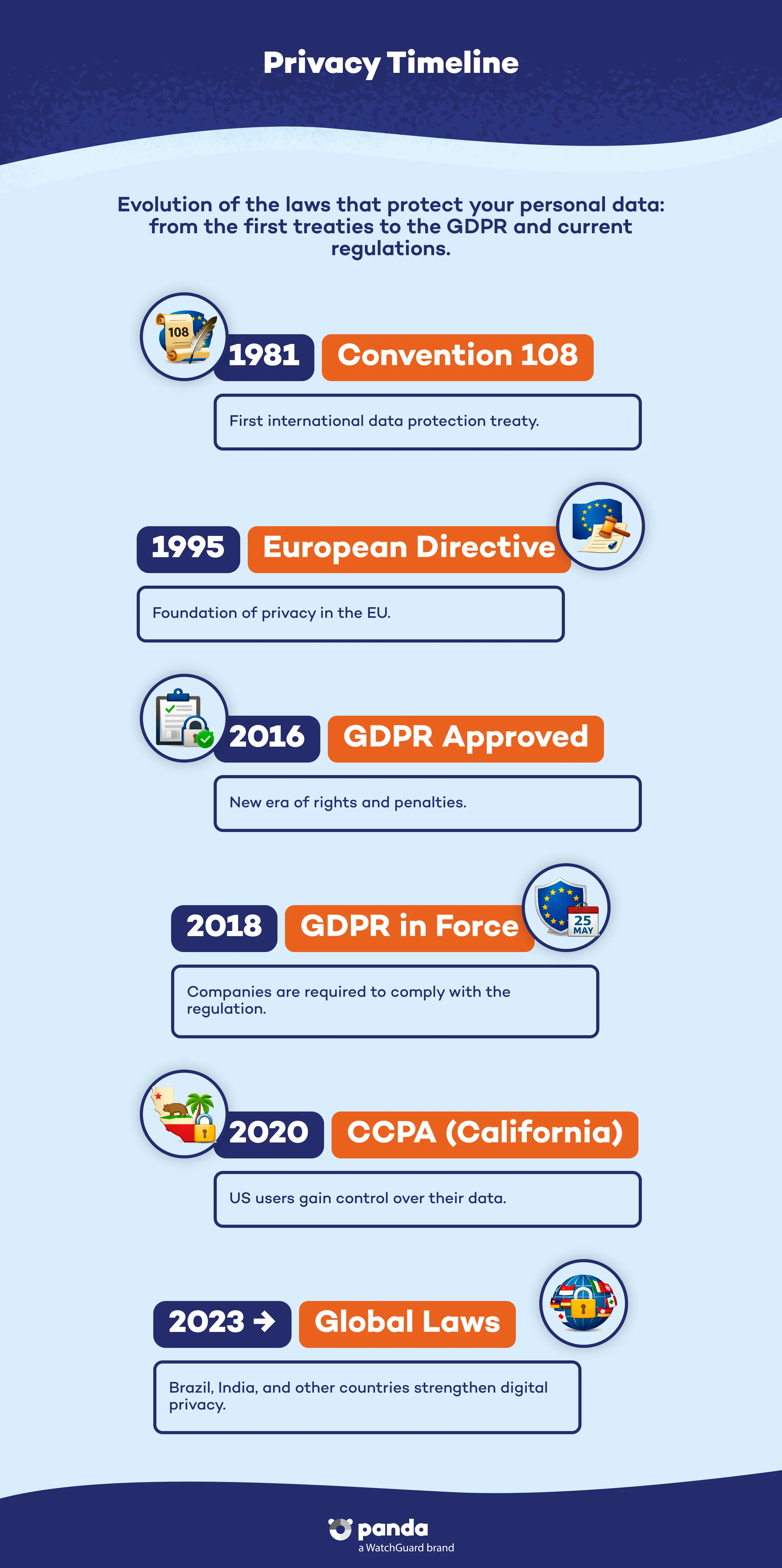
Although privacy has always been a principle in law as well as in ethics, it has only recently been integrated into international law. Convention 108 of the Council of Europe (1981) was the first international agreement on personal data protection.


Today, privacy is recognized as a fundamental right, and its violation has ethical, legal, and technological implications. The evolution of artificial intelligence, big data, and social media means that data protection strategies need to be constantly updated.

Privacy timeline - Panda Security

Why is Privacy Important?

In our current digital age, privacy has become a key issue due to the growing amount of personal information we share and store. Protecting the confidentiality of our data, such as images, messages, or browsing history, is essential to our security and even our well-being. This protection is even more relevant today with advances in technologies such as generative AI, which can process large volumes of data without consent and has the ability to re-identify individuals from seemingly anonymous information. This represents a challenge when it comes to safeguarding our identity.


Protecting privacy is not only an ethical and security necessity, but also a legal obligation in many regions. Legislation such as the General Data Protection Regulation (GDPR) in Europe sets clear standards for the proper handling of personal information, and failure to comply can result in significant penalties. Therefore, adopting measures to safeguard privacy is essential. This is necessary to ensure a secure digital environment that respects individual rights in an increasingly interconnected and technology-dependent world.

Main Threats to Privacy

Privacy is threatened by both malicious adversaries and automated systems that collect and process data without sufficient transparency.


Monetizing of Personal Data


Platforms such as social networks, search engines, and free apps obtain large amounts of user data to create commercial profiles. This turns privacy into a commodity, whereby users give up personal data in exchange for seemingly free services. A recent case is that of Meta, which, from June 26, allows your data to be used to train its artificial intelligence systems if you interact with its chatbots. This practice has reignited the debate on informed consent and the limits of commercial use of personal information.


Espionage and Mass Surveillance


Leaks such as those by Edward Snowden revealed massive government espionage networks (NSA, among others), with access to millions of private communications worldwide. Surveillance without democratic control poses a threat to civil rights and freedom of expression. Added to this is the creation of detailed profiles based on browsing habits and online usage, a form of algorithmic surveillance that raises ethical risks and can lead to automated bias or discrimination.


Cyberattacks and Data Leaks


Incidents such as security breaches on Facebook or data leaks from popular apps highlight how even the largest platforms are vulnerable. Once your data is online, it is almost impossible to delete it completely. Moreover, content shared on social media —such as images of children— can be reused without control, extending the potential scope of the damage.


Generative Artificial Intelligence and New Risks


Developments in generative artificial intelligence have added a new layer of threats to privacy. Training these models requires a huge amount of data, much of which is collected without the explicit consent of users. Added to this is the possibility of re-identifying individuals from supposedly anonymized information. This technique undermines current data protection guarantees. Moreover, AI models can also be targeted by attacks aimed at stealing confidential information including their training or data capture databases while they are operating.


These developments are nevertheless an incredible innovation, and various options are starting to become available to everyone. Yet it is important to set some limits from the outset, learn how to use the tools without compromising privacy, or even choose not to use them at all if you are uncomfortable with the methods used to collect and process your data.

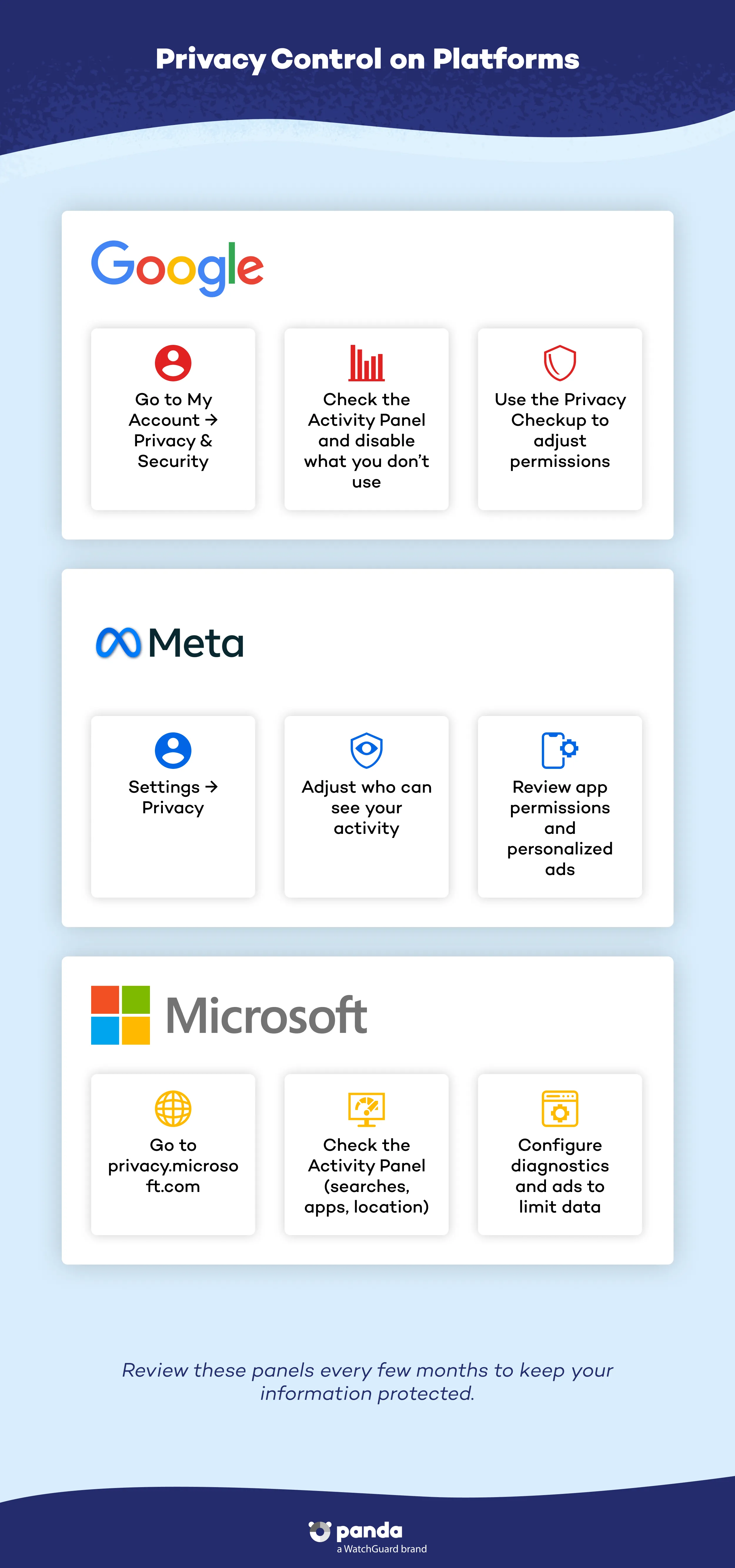
Privacy control on platforms: Visual steps for Google, Meta, and Microsoft. - Panda Security

Differences Between Privacy and Security

The protection of personal information in digital environments does not depend on a single factor, but rather on a combination of factors that complement each other. Two of the key concepts in this area are privacy and security. Although they are often confused, they fulfill different yet interrelated functions.


Privacy refers to the right of each person to decide what data to share, with whom, and for what purpose. It is the conscious control over personal information, such as photos, location, browsing habits, or communications.


On the other hand, security is based on technical tools and measures that prevent unauthorized access. Such as the use of firewalls, encryption, antivirus, or authentication systems. Its purpose is to protect data from cyberattacks, leaks, or any form of manipulation or theft.


Although they are different concepts, privacy and security have to be coordinated in order to safeguard your information. Weak security can compromise privacy, and a lack of control over data can nullify any technical protection efforts. Only by integrating both can an effective defense against today's digital threats be guaranteed.

How to Protect Your Privacy Online: Key Steps

In an increasingly connected and automated world, protecting your privacy is essential. Whether you are an individual user or manage an organization, these practices will help you keep your personal and professional data secure.


1. Analyze Your Digital Footprint


Search for your name on Google and check the information that appears about you. This simple action enables you to find out what personal data is publicly accessible. You can exercise your data protection rights by requesting the removal of results directly from a website’s owners or, in some cases, from the search engines themselves.In addition, avoid sharing sensitive information (such as personal documents or compromising photos) on public platforms or chatbots. This information can be stored, reused, or used to train artificial intelligence models without your consent.


2. Configure Your Social Media and AI Accounts Correctly


On platforms such as Facebook, you can limit who sees your posts, photos, or history. Check the privacy policies and customize the settings according to your preferences.This advice also applies to AI tools such as Google Gemini or Bing AI, which can collect data on your interactions. Be sure to review their privacy settings, as many allow you to adjust the collection and use of information.


Additional tip: Only download apps from trusted sources and restrict the access you grant to features such as location, camera, or contacts.


3. Use Advanced Security Solutions


Protecting your browsing and your devices is key to maintaining privacy. With tools such as Panda Dome, you can:


  • Encrypt your connection with a VPN so you can browse anonymously.
  • Detect and block trackers, malware, and spyware.
  • Manage secure passwords with Panda Dome Password Manager.
  • Add a layer of encryption to your most confidential communications.


Check out our security solutions to choose the protection that best adapts to your profile.


4. Protect Your Privacy in the Workplace


Organizations also need to take responsibility for protecting personal data. Some key measures include:


  • Installing professional cybersecurity solutions.
  • Enforcing GDPR compliance policies and data governance frameworks.
  • Encrypting information with secure protocols and using technologies such as DLP (Data Loss Prevention) to prevent leaks in AI environments.
  • Appointing a Data Protection Officer (DPO) and maintaining transparent privacy policies.
  • Training staff in best practices for handling confidential information.


Digital privacy is not just an option; it is a right that must be actively protected in every online interaction.


Download our free eBook “Data Privacy: A Guide for Individuals and Families”.

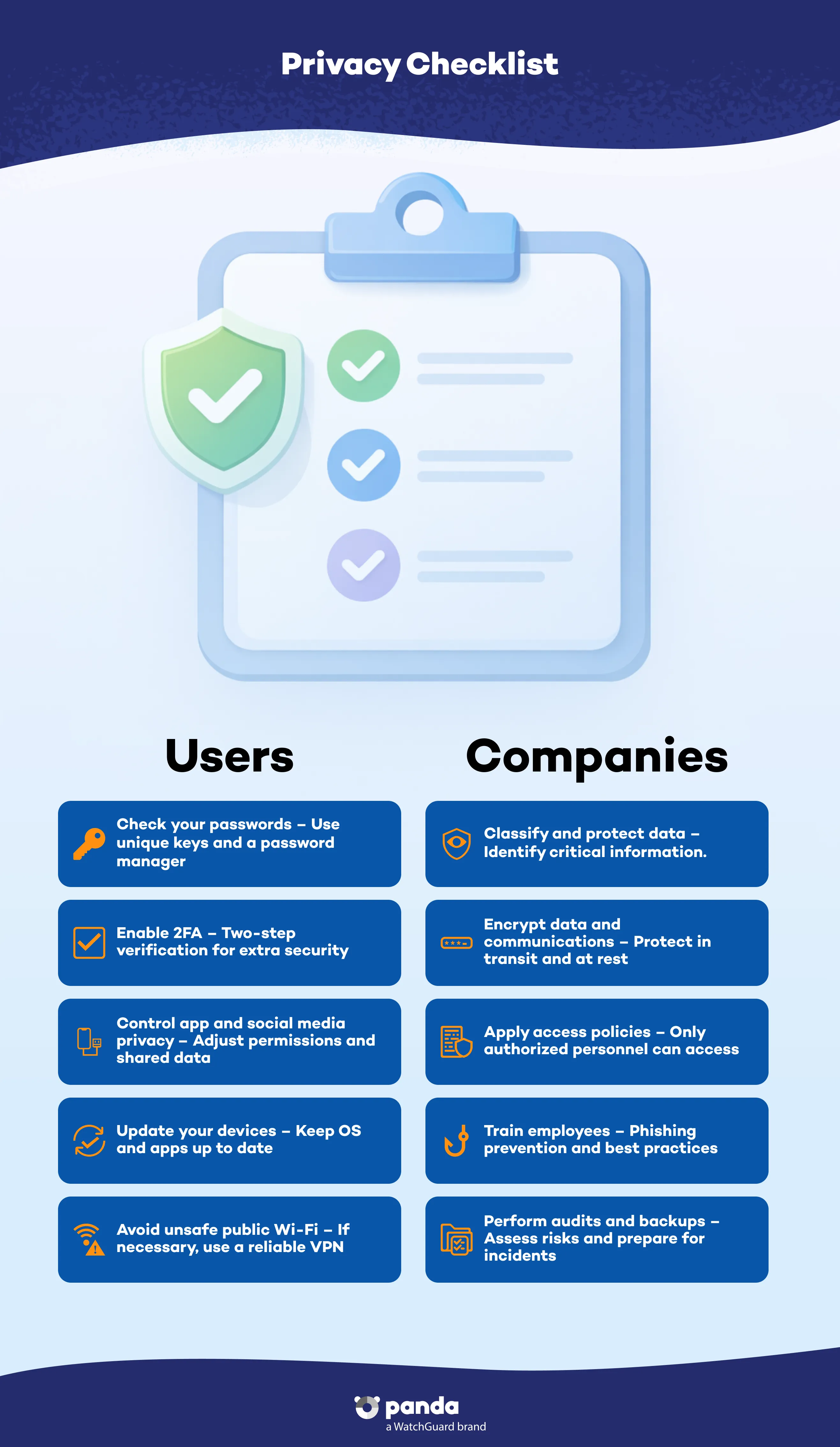
Privacy checklist: Key actions for users and companies.- Panda Security
Privacy FAQs
What Is the Difference Between Privacy and Security?
Privacy refers to the control you have over your personal information. Security is the set of measures taken to protect that information from unauthorized access.
What Are the Risks of Sharing Too Much Information on Social Media?
Exposure to fraud, identity theft, or blackmail. It can also lead to the creation of profiles that can be used for political or commercial purposes.
Can AI Protect (or Violate) My Privacy?
Yes. AI can help detect cyberthreats and improve permission management. But it can also collect and process data without transparency.
Can AI Guess My Personal Data?
Yes, especially generative AI which uses large databases and can extract confidential data without consent.
How Can I Prevent My Data from Being Used in Chatbots?
Review the policies and adjust settings on platforms such as Meta, Google, or Microsoft to exclude any of your data that could be acquired through interactions.
Is It Safe to Upload Images to AI Apps?
Not entirely. They can collect your photos and use them commercially without explicit consent.
What Should I Do if My Company Uses AI Without Restrictions?
Implement data governance (DLP, encryption, DPO) and review GDPR compliance to avoid penalties.

Need help?

Call us 24 hours a day, 7 days a week, and get a free diagnosis.

Additional resources

Digital security is everyone's responsibility. With the right information and tools, you can reduce risks and use the Internet with peace of mind. Explore our guides and protect your online privacy.