GDPR: General Data Protection Regulation

What Is GDPR?

The General Data Protection Regulation (GDPR) is the European regulation that governs how organizations must manage and protect the personal data of European citizens. It came into effect on May 25, 2018, and has since become established as a global reference point for privacy and information security.


This regulation requires companies and other entities to be transparent, obtain explicit consent, and guarantee rights such as access, rectification, and deletion of data. It continuously adapts to technological advances and digital challenges, such as artificial intelligence, crypto assets, and massive international data transfers.

Try Panda Dome for:Windows | Android | Mac | iOS

Why Is the GDPR Important Today? Scope of Application

Technological developments and widespread digitalization have increased the risks associated with privacy. The GDPR is mandatory for all organizations that handle the personal data of European Union residents, regardless of where they are physically located. This legal framework has set a global standard for data protection and remains the benchmark for ensuring privacy in the digital age.


Consequently, the GDPR is still essential for:

  • Protecting users from misuse of information or data leaks.
  • Demanding accountability and transparency from companies, administrations, and digital services.
  • Adapting to new challenges, such as the use of artificial intelligence and international data transfers.


Massive digitalization and increased threats to privacy make the GDPR more relevant than ever today to protect users from data misuse or leaks, to hold companies accountable, and to adapt to new risks such as AI.

What's GDPR - Panda Security

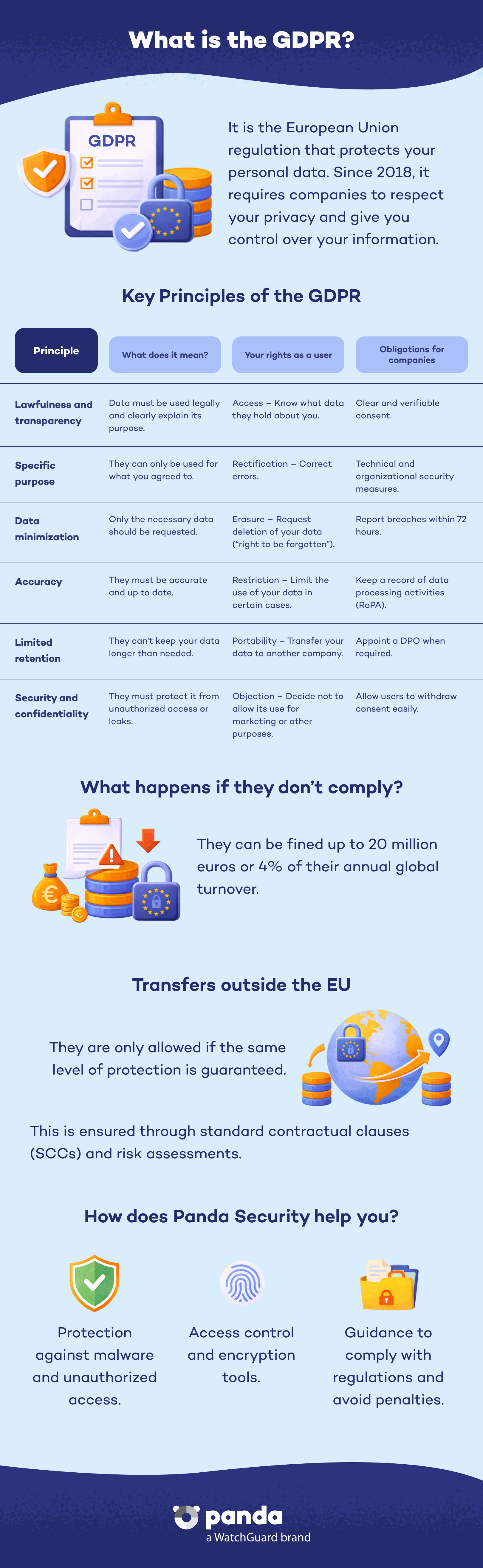
Basic Principles of the GDPR


Integrity and confidentiality: Data security must be protected to prevent unauthorized access.


  • Lawfulness, fairness, and transparency: User data must be processed lawfully and transparently.
  • Purpose limitation: Data may only be used for the purpose stated when it was collected.
  • Data minimization: Only the data that is strictly necessary for the purpose may be gathered.
  • Accuracy: Data must be kept up to date and corrected if incorrect.
  • Storage limitation: Data cannot be stored for longer than necessary.

User Rights Under the GDPR

The GDPR grants citizens several fundamental rights to exercise control over their information:


  • Right to access data: You have the right to know what information an entity has about you.
  • Right to rectification: You are entitled to correct inaccurate or incomplete data.
  • Right to erasure: You can request the deletion of data when it is no longer necessary or you withdraw consent.
  • Right to restrict processing: You have the right to restrict the use of your data in certain circumstances.
  • Right to data portability: You may obtain your data in a digital format and transfer it to another provider.
  • Right to object: You are entitled to object to the processing of data for marketing or other legitimate purposes.


These rights have improved transparency and generated greater trust in digital relationships.

What Obligations Do Companies Have Under the GDPR?

Organizations are obliged to:


  • Obtain explicit, informed, and verifiable consent to process personal data for specific purposes.
  • Implement technical and organizational measures to protect data against unauthorized access, loss, or breaches.
  • Keep a record of activities (ROPA) and carry out impact assessments (DPIA) on high-risk processing.
  • Notify the authorities and those affected within a maximum of 72 hours in the event of security breaches.
  • Appoint a Data Protection Officer (DPO) when required.
  • Allow users to withdraw their consent as easily as they gave it.

Fines and Penalties for Non-Compliance

Non-compliance with the GDPR can result in fines of up to 4 percent of global annual turnover or €20 million, whichever is higher. In 2024-2025, the Spanish Data Protection Agency (AEPD) and other European authorities imposed record penalties:


  • TikTok (Ireland): €530 million fine for illegal data transfers to China.
  • Meta (Facebook, Instagram): €1.2 billion for irregular transfers to the USA.
  • Orange Spain: €1.2 million for failures in SIM duplicate management.
  • Vodafone Germany: €45 million for portal security failures.


Moreover, European courts recognize compensation for loss of data control even if where there is no proven material damage, expanding the scope of protection.

International Data Transfers

The GDPR requires that any data transfer outside the European Economic Area guarantees an equivalent level of protection. With the end of the Privacy Shield, mechanisms such as standard contractual clauses (SCC) and detailed assessments are particularly important in order to avoid million-dollar fines.

How Can Panda Security Help You Comply with the GDPR?

At Panda Security, we offer solutions that help you:


  • Protect your infrastructure and data against malware, ransomware, and advanced attacks.
  • Manage privacy with tools that control access and use of sensitive data.
  • Implement security policies that ensure legal compliance and prevent data breaches.


Check out our advanced security solutions for businesses and individuals at Panda Security. And if you need support or guidance, visit our resource center and blog with up-to-date content at Panda Media Center.

RGPD FAQs
Does the GDPR Only Affect European Companies?
No. It applies to any organization that processes data from European citizens, even if its headquarters are outside the EU.
What Is a Security Breach According to the GDPR?
A security breach that compromises the confidentiality, integrity, or availability of personal data.
How Long Does It Take the AEPD to Resolve a Complaint?
The Agency has a maximum of three months to resolve complaints, which may be extended if the case is complex.
Can I Claim Compensation for a Breach of the GDPR?
Yes, you can claim compensation if you suffer material or non-material damage as a result of the breach.
Does the GDPR Apply to My Company's WhatsApp?
Yes, if you process data from European citizens.
Can I Claim Compensation Based Solely on Fear of Data Misuse?
European courts usually require proof of actual damage, although some accept compensation for “loss of control.”
What Do I Need to Do to Transfer Data Outside the EU?
You must use standard contractual clauses (SCC) or other mechanisms that guarantee equivalent protection.
Related Topics

Need help?

Call us 24 hours a day, 7 days a week, and get a free diagnosis.

Additional resources

Digital security is everyone's responsibility. With the right information and tools, you can reduce risks and use the Internet with peace of mind. Explore our guides and protect your online privacy.