Revenge Porn

What Is Revenge Porn?

Understanding This Form of Online Harassment.

Revenge porn consists of the posting or spreading on the Internet of compromising images or videos without the permission of the person involved.

Try Panda Dome for:Windows | Android | Mac | iOS

What Is This New Form of Harassment: Revenge Porn?

Although it often results from broken romantic relationships, the act of sharing this type of content becomes a form of online violence with serious legal, emotional, and social consequences for the victims, most of whom are young women.


Fortunately, an increasing number of countries are recognizing this type of violence as a crime in its own right and are adapting their laws accordingly to protect victims.

Why Is It Such a Harmful and Dangerous Form of Harassment?

Revenge porn is not only a violation of privacy; it represents a direct assault on an individual that can hurt the victim emotionally and damage their reputation. Posting intimate material without consent can lead to anxiety, depression, loss of self-esteem, social isolation, and, in many cases, PTS symptoms. Moreover, as these actions mostly occur on social networks or similar platforms, the content can remain accessible for years, exacerbating the long-term damage.


The consequences are not just emotional; in some countries, revenge porn is considered a crime. Victims can demand the removal of the content and report the person responsible to the authorities, claiming compensation and holding the perpetrator criminally responsible. Recognizing this as a criminal act is the first step to helping victims take action.

What Does the Law Say About Revenge Porn Around the World?

Spain


Since 2015, Article 197.7 of the Spanish Penal Code dictates up to one year in prison or a fine for anyone who posts intimate content without consent, even if it was obtained with permission. The sentences are stiffer if the perpetrator is a partner or ex-partner of the victim.


France


Since 2016, the French Penal Code punishes the posting of intimate images without consent with up to two years in prison and a fine of €60,000, even if there is no intent to profit from it.


United Kingdom


The Revenge Porn Law of 2015 considers it a crime to publish or share intimate content without consent, and with the intent to cause harm. This can be punished with up to two years imprisonment. Since 2021, the law also contemplates threats of publication (threat-based abuse).


USA


While there is no federal law, 48 of the 50 states do have specific laws. In states such as California, New York, or Texas, revenge porn can carry penalties of up to five years in prison as well as fines. Victims are also allowed to sue for damages.


Mexico


Thanks to the Olimpia Law (a pioneering legal reform), digital violence is classified as a crime throughout the country. Publishing intimate content without consent can result in sentences of between three to six years in prison as well as fines, with more severe sentences in the case of relationships or where the crime is motivated by profit.


Netherlands


Since 2020, non-consensual publication of intimate images has been a criminal offense in the Netherlands. Penalties can reach up to two years in prison, and if intent to take revenge on or harm the victim is proven, up to four years. The threat of publication is also punishable.


Italy


Italy criminalized revenge porn in 2019 with the Red Code Law. The offense carries penalties of one to six years in prison and fines of up to €15,000. Penalties are stiffer if the perpetrator is an ex-partner or if the victim is a vulnerable person.


Sweden


In Sweden, since 2018, revenge porn has been considered a form of violation of privacy and sexual integrity. It is punishable with up to two years in prison and is usually considered a serious act of defamation or harassment.


Germany


Germany does not have a specific law for revenge porn, but it punishes it under offenses such as violation of privacy and harassment, according to Article 201a of the German Penal Code. Penalties include up to two years of imprisonment as well as fines.


Brazil


Brazil penalized the non-consensual disclosure of intimate content in 2018. Penalties range from one to five years in prison, with harsher sentences if there is or was an emotional relationship between the offender and the victim.


Canada


Since 2015, the Canadian law prohibits the non-consensual dissemination of intimate images, with penalties of up to five years in prison. It is also possible to demand the immediate removal of the content and seizure of devices.


Australia


Australia has some of the most advanced laws in this field. The Enhancing Online Safety Act allows victims to report these offenses and ensure that offending content is rapidly removed. Offenders can be punished with up to seven years in prison, and the government has an Electronic Safety Office specifically dedicated to this type of crime.


In the European Union, the General Data Protection Regulation (GDPR) reinforces fundamental rights regarding personal image and privacy in the digital environment. Although there is no common criminal law in the EU for revenge porn, many member states have developed specific legislation to classify this crime or frame it within areas such as violation of the right to privacy, harassment, or digital gender-based violence.

How to Prevent Revenge Porn

Revenge porn can severely affect people's lives, both emotionally and legally. Although no one is completely safe from having their privacy violated, there are specific measures you can take to significantly reduce the risk of falling victim to this crime. Here we detail how to protect your digital privacy and help ensure a safe environment, both for yourself and for those around you.


1. Avoid Creating or Sharing Intimate Content

This applies even with people you trust. Remember that it is impossible to have complete control over a digital file. A breakup, a hack, or the loss of a device can lead to a file being leaked.


2. Use Secure Platforms

If you do decide to share intimate content, do so with apps that provide end-to-end encryption, self-deleting messages, and password protection.


3. Protect Your Devices

Install cybersecurity software, such as Panda Dome, and avoid storing sensitive files without encryption or two-factor authentication.


4. Awareness and Education

Digital education is essential for teenagers and young people in general. Teaching about consent, privacy, and respect can prevent digital violence from an early age.


The best defense against revenge porn is conscious and proactive prevention. Avoid creating intimate content, use secure platforms, and protect your devices properly. These are fundamental steps to take. Additionally, education from an early age about digital risks and respect in the online environment is fundamental to eradicating this type of violence. Remember: in the digital age, privacy can also be protected through awareness and responsibility.

How to Know Whether You Are a Victim of Revenge Porn

You become a victim when someone shares explicit content of you without your consent. This could be on social media, forums, chats, or even through anonymous links on the Internet. Even if you actively shared that content at some point, it does not mean that someone has the right to publish it without your permission. Recognizing that you are a victim is essential to initiating a legal, emotional, and technical response.

What to Do If You Are a Victim of Revenge Porn

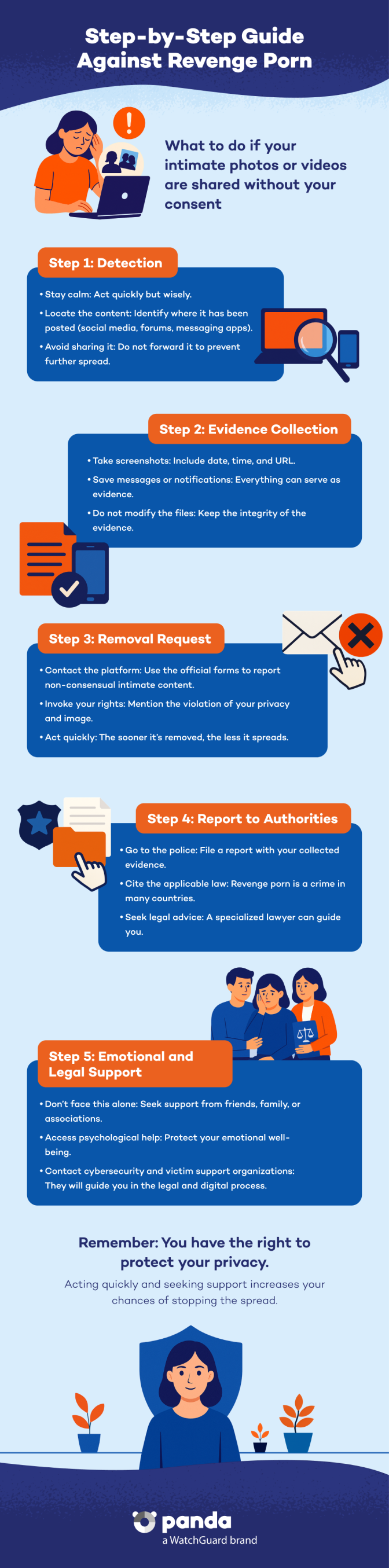
The most important thing is to act quickly. Below, we outline the key steps to take if you discover that your intimate content has been shared without your consent:


Gather Evidence Immediately


Save screenshots, URLs, broadcast messages, and any data that can help identify the perpetrator or the source of publication.


Request the Removal of the Content


Contact the platform where the material has been shared. Social networks such as Facebook, Google, or X (formerly Twitter) have specific forms to report unauthorized intimate content.


Use Official Help Channels


Some countries, including Australia and the United Kingdom, have rapid response portals and support services for victims of digital violence.


Consult Professionals if the Content Is Not Removed


You can turn to specialized services for removing content on the Internet to manage the process legally and technically.


Report Cases to the Relevant Authorities


In many countries, there are specialized units for tech crimes that can investigate the case. The evidence collected will be key to advancing legally and charging those responsible.


Seek Psychological and Legal Support


Revenge porn has a strong emotional impact. There are NGOs, legal services, and specialized platforms that provide comprehensive support to victims.


Dealing with revenge porn can be devastating, but you are not alone. Acting quickly, seeking specialized help, and reporting the crime to the authorities are fundamental steps to stop the harm, regain control, and commence recovery. Information, support, and the law are on your side.

Guide to dealing with revenge porn - Panda Security
Revenge Porn FAQs
Is Revenge Porn a Crime in All Countries?
No. Although more than 80 countries have regulated against revenge porn, many still do not consider it a crime in its own right.
What Can I Do If I Am a Target of Revenge Porn?
Gather evidence, request immediate removal, seek specialized services to manage online deletion, and file a formal complaint as soon as possible.
Can I Report It If the Perpetrator Is in Another Country?
Yes, although the process is more complex. You can approach international organizations or report it through global platforms such as Interpol or Europol.
What Should I Do If I Am Only Threatened with the Publication of Content?
It is also a crime in many countries. Keep the evidence and report it.

Need help?

Call us 24 hours a day, 7 days a week, and get a free diagnosis.

Additional resources

Digital security is everyone's responsibility. With the right information and tools, you can reduce risks and use the Internet with peace of mind. Explore our guides and protect your online privacy.