Almost every year we hear that passwords are dead (we even wrote about back in December 2023). But now three years later, the vast majority of businesses and consumers still rely on passwords every day. And the consequences are serious.
Stolen credentials are now the initial access vector in 22% of all data breaches, according to Verizon’s 2025 Data Breach Investigations Report (DBIR). The good news: practical alternatives exist, and you don’t need to be a tech expert to take advantage of them. This article explains the risks of password dependency – and what you can do to protect yourself.
Key takeaways
- Most businesses and consumers still rely on passwords – and cybercriminals know it.
- Poor password habits significantly increase your exposure to identity theft and fraud.
- A password manager is one of the simplest and most effective steps you can take to protect yourself right now.
- Passwordless authentication and zero trust security represent the longer-term future.
Why are passwords still such a problem?
Despite years of security advice, password habits remain dangerously weak. Research shows that on average, people reuse passwords across 52% of their accounts. That means a single breach – say, a shopping site you signed up to years ago – can quickly compromise your email, bank account, or workplace login.
The scale of the problem is enormous. Billions of credentials circulate on dark web marketplaces, harvested from years of corporate breaches. If you’ve ever reused a password – and statistically, most people have – there’s a real chance some version of your credentials is already out there.
What is the real risk to you?
For individuals, the consequences of compromised credentials range from the inconvenient to the devastating. Identity theft, unauthorized purchases, drained bank accounts, and locked social media profiles are all common outcomes of a single stolen password. Cybercriminals don’t need sophisticated tools to exploit reused credentials – automated software does the work for them, testing leaked passwords against hundreds of sites in minutes.
How can a password manager help?
A password manager is one of the most impactful – and underused – security tools available to everyday users. At its core, it does two things: generates strong, unique passwords for every account and remembers them so you don’t have to. That single change eliminates the most common vulnerability of all: reuse.
Here’s what a good password manager like Panda Dome Password Manager offers in practice:
- Unique passwords for every account. If one site is breached, your other accounts stay safe because no two passwords are the same.
- Breach monitoring. Many password managers automatically alert you if your credentials appear in a known data breach, so you can act before an attacker does.
- Secure sharing. Rather than sending passwords via text or email, you can share access securely with family members or colleagues without ever revealing the underlying credentials.
- Autofill protection. Password managers only autofill credentials on the correct site – a built-in defense against phishing pages designed to mimic legitimate ones.
When choosing a password manager, look for one built on zero-knowledge encryption, meaning the provider never has access to your vault and its contents.
What does the passwordless future look like?
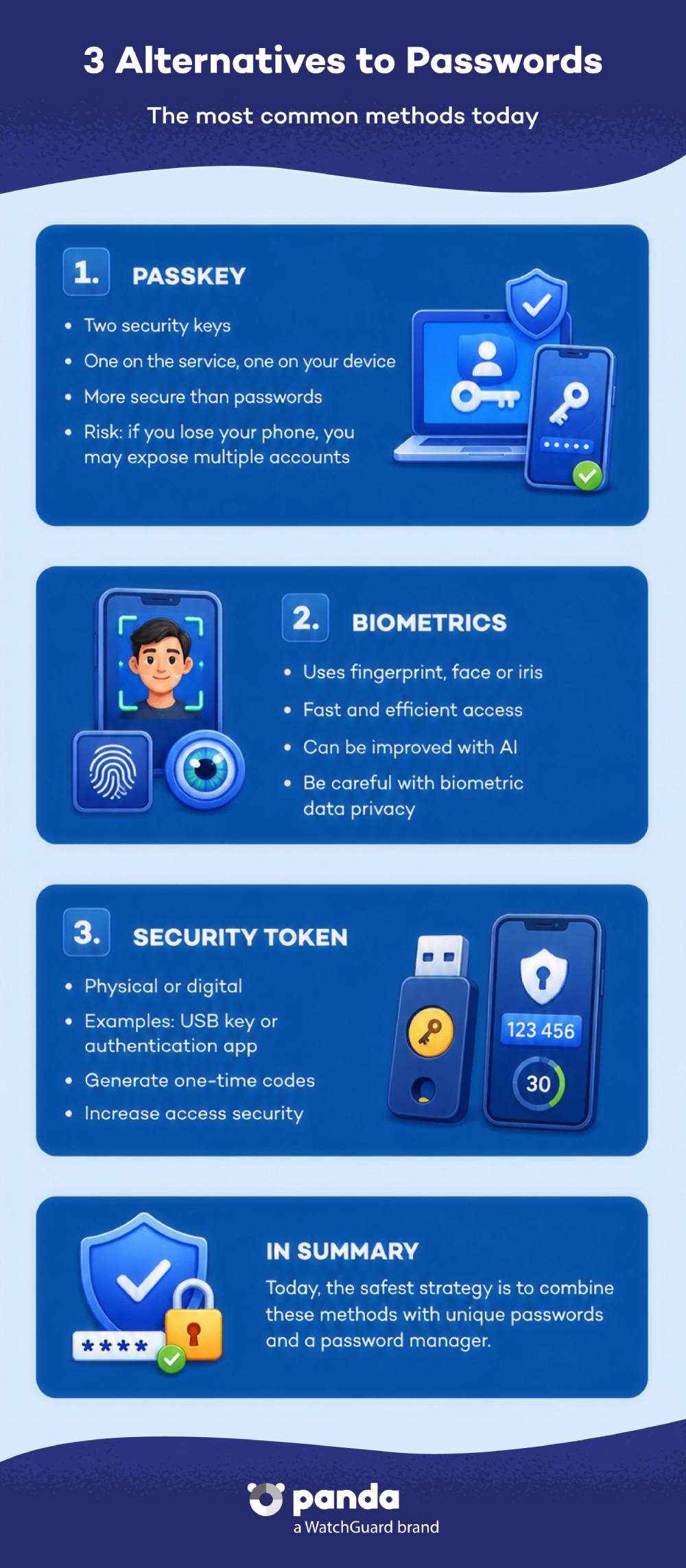
Password managers solve today’s problem, but the industry is working toward eliminating passwords altogether. Passwordless authentication – using passkeys, biometrics, or hardware tokens – verifies your identity through something you have or something you are, rather than something you know. Major platforms including Apple, Google, and Microsoft now support passkeys, and adoption is growing fast.
For businesses, a broader shift to zero trust security is also underway. Zero trust operates on the principle of “never trust, always verify” – requiring every access request to be authenticated regardless of location, rather than assuming anyone inside a network is safe. For consumers, this translates to better-protected services and fewer breaches at the companies you share your data with.
It is likely that most organizations won’t fully replace passwords for several years – so for now, strong password hygiene backed by a reliable password manager remains your best line of defense.
Start protecting yourself today
You don’t need to overhaul your entire digital life overnight. Start with a password manager, enable multi-factor authentication (MFA) on your most important accounts, and replace your most reused passwords first. Small changes compound quickly into meaningful protection.
The Panda Dome suite of tools is designed to make this straightforward – whether you’re protecting a personal device or a small business network. Explore the range to learn more.