



Dark AI refers to the usage of AI to create scams, fake messages, malware and deepfakes. This makes online attacks easier to launch and harder to spot.
AI can write emails, create images and answer questions in seconds, but cybercriminals can also misuse it to scam, trick or hack you more efficiently. That’s dark AI: AI built for malicious purposes.
And the adoption of dark AI is increasing, with the dark web intelligence market expected to reach $2.1 million by 2030, growing at a fast 21.8% yearly rate. That growth signals rising demand for tools that monitor hidden online activity. This means scams may look more convincing, fake content may feel more real and attacks may happen more often.
All of this makes it important to know what dark AI is and how criminals use it. Explore that and the steps to protect your devices, money and personal data from prying eyes.
How Cybercriminals Use Dark AI
Cybercriminals use dark AI to create smarter scams faster. Tools found on the dark web AI marketplaces and illegal dark LLMs make advanced attacks possible even for people with little technical skill.
Here are some of the most common ways cybercriminals use dark AI and how they can affect you:
- Social engineering: Dark AI can study your online activity and craft messages that feel personal. You may receive texts or emails that sound like they came from your bank, employer or even a friend.
- Adversarial AI attacks: Cybercriminals can trick security systems by slightly changing files, images or data so AI tools fail to detect threats.
- Voice cloning: AI can copy someone’s voice using short audio clips. Cybercriminals use this for urgent calls that sound like a family member asking for money or access codes — a common tactic in deepfake love scams.
- Attack automation: AI tools can scan thousands of devices at once to find weaknesses. This increases the number of attacks and gives you less time to react.
- Malware creation: AI helps attackers write harmful software faster. Even beginners can create viruses that steal passwords or spy on your device.
- Large-scale attacks: AI makes it easy to send millions of scam messages at once. Even if only a small number of people fall for the trick, criminals can still make money.
- Phishing content generation: AI can write realistic emails, fake login pages and messages with almost perfect grammar. Scammers use AI to build fake websites that closely mimic trusted brands.
- Bypassing biometrics: Some attackers use AI-generated faces, voices or fingerprints to fool identity checks used by banking or mobile apps.
How Agentic AI Makes These Attacks More Dangerous
New agentic AI tools can act on their own. Instead of just writing a scam email, they can plan the attack, create malware, send messages and adjust tactics automatically.
Researchers from Google DeepMind found that attackers can create AI agent traps — hidden instructions on websites that manipulate AI tools into leaking data or performing harmful actions.
For example, a malicious website could secretly give instructions to an AI agent, which can then share your sensitive data or spread false information without you realizing what happened.
The Impact of Dark AI
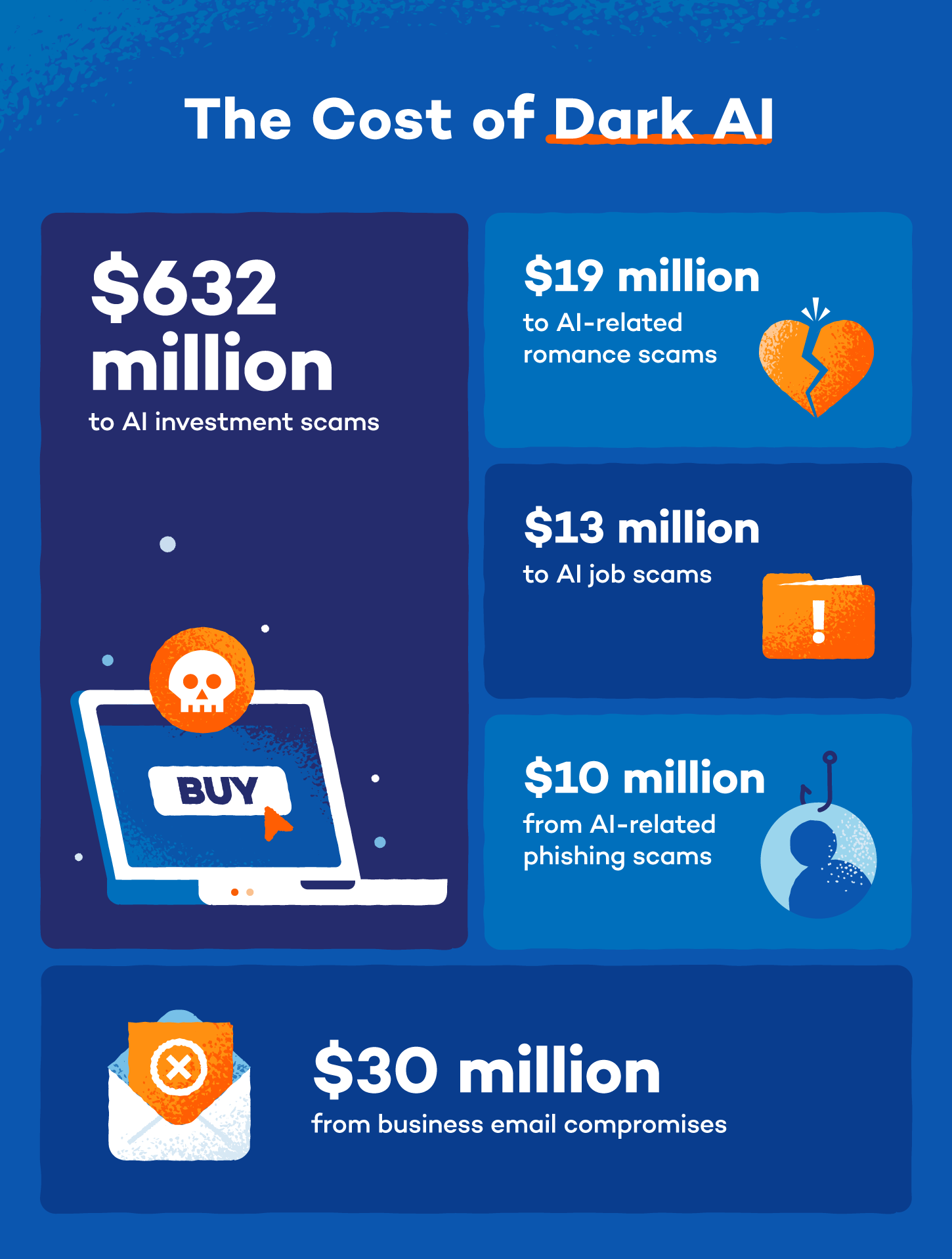
Dark AI is already causing real financial harm. The latest IC3 report (2025) shows over $893 million in losses across more than 22,000 AI-related complaints, highlighting how quickly AI-powered scams are growing.
Here are key findings from the 2025 IC3 report and how dark AI plays a role:
- AI-related cybercrime: Victims reported 22,364 complaints linked to AI, with losses exceeding $893 million. Criminals use dark LLMs to generate convincing fake messages, voices and videos that are harder to detect.
- Employment fraud: The US lost nearly $13 million to AI-related job scams. Attackers may use deepfake video interviews or AI-generated resumes to gain access to company systems or steal personal information.
- Investment scams: Losses tied to AI-related investment fraud exceeded $632 million, while total investment scam losses surpassed $8 billion. Scammers use AI to create fake celebrity endorsements, websites and chats that feel legitimate.
- Data breaches: Over 1,200 complaints involved AI-related personal data breaches. Criminals can use stolen information to create highly targeted phishing messages that feel personal and urgent.
- Business email compromise (BEC): AI-assisted BEC scams caused more than $30 million in reported losses. AI tools can mimic writing styles and create emails that appear to come from trusted coworkers or companies.
- Romance and confidence scams: Victims lost over $19 million to AI-supported romance scams. Deepfake photos, chatbots and voice cloning help scammers build trust over time.
- Phishing and spoofing: AI-related phishing scams caused over $10 million in losses. Scammers use AI to build fake websites and emails that closely copy trusted brands.
These numbers show how dark AI helps criminals scale attacks faster and reach more people. Even small scams can feel highly personal, increasing the likelihood that someone will click, download or share sensitive information.

Real-World Dark AI Tool Examples
Some dark AI tools are built from scratch, while others are malicious clones of existing systems. Think of them as altered versions of familiar tools — similar to a dark ChatGPT or DarkGPT — but designed to help cybercriminals. Many are trained on data from the dark web or modified to remove safety limits, making them useful for scams and malware.
FraudGPT
FraudGPT is a DarkGPT-style tool designed to help scammers create convincing phishing emails, fake websites and social media scams. It can generate messages that sound natural and urgent, making them harder to spot.
Cyber criminals can quickly produce large volumes of scam content, including pages that imitate banks or shopping sites — a tactic often seen when scammers use AI to build fake websites targeting regular users.
WormGPT
WormGPT is an AI tool built specifically to support cybercrime, including malware creation and phishing campaigns.
It removes the safety protections found in mainstream AI systems, allowing attackers to generate harmful code or scam messages with ease. Even someone with little technical skill can use WormGPT to create convincing attacks that look polished and trustworthy.
PoisonGPT
PoisonGPT shows how attackers can secretly modify AI models to spread false or misleading information. In demonstrations, researchers altered a language model to generate fake news responses without obvious warning signs.
This type of manipulation could influence what you see online, especially through AI chatbots with built-in web browsers that automatically pull information.
DarkBERT
DarkBERT is trained on data from the dark web, giving it insight into how cybercriminals communicate and operate. While researchers developed it to study threats, similar models could help criminals refine scams or identify targets more effectively. This shows how AI can learn from hidden online communities and improve attack strategies.
Misuse of Everyday AI Tools
Not all dark AI comes from custom-built tools like FraudGPT or WormGPT. Many attackers misuse everyday tools like ChatGPT and Google Gemini by combining them with other software or using workarounds to bypass safety limits.
For example, scammers can use these tools to draft realistic phishing emails, create fake job offers or generate scripts for scam calls. When paired with voice cloning or image manipulation tools, this can lead to convincing scams, such as deepfake love schemes or impersonation attacks.
This makes it easier for people with little technical skill to run large-scale scams, turning simple ideas into polished attacks that are harder to spot.
How to Protect Yourself From Cybercriminals Using Dark AI Tools
Dark AI can make scams look more believable, but simple habits still go a long way. These practical tips help you stay one step ahead without needing technical skills:
- Use AI security tools: Modern security tools use AI to detect suspicious behavior in real time. For instance, Panda Dome antivirus continuously analyzes files, links and apps to help stop threats before they harm your device.
- Verify who you are speaking to: AI can clone voices and write realistic messages, making scams feel personal. If someone asks for money, passwords or urgent action, pause and confirm through another channel. This helps protect you from phishing, vishing (voice phishing) and deepfake scams.
- Strengthen account security: Use strong, unique passwords for every account and enable multi-factor authentication (MFA) whenever possible. Even if criminals expose your password in a data breach or “ChatGPT hacked” style scam headlines cause confusion, MFA makes it much harder for criminals to access your accounts.
- Use trustworthy services: Choose companies that actively invest in cybersecurity and work with the security community to fix risks quickly. Trusted platforms are more likely to detect threats like new malware types or emerging phishing campaigns before they reach users.
- Remove your information online: Limit how much personal information is publicly available. Data such as your email, phone number, workplace or birthday can help attackers create highly targeted scams using dark AI tools.
- Private your social media pages: Adjust privacy settings so only people you trust can see your posts and personal details. This helps block AI from your social media data, making it harder for scammers to build convincing fake messages or profiles.
- Avoid public Wi-Fi for sensitive tasks: Public Wi-Fi networks can expose your data to attackers. Avoid logging into banking apps, email or other important accounts on shared networks unless you use a secure connection.
Keep Dark AI at Bay With Panda Security
Dark AI-powered threats are getting smarter, but your protection can, too.
Panda Dome uses advanced AI and machine learning to detect suspicious behavior, block new types of malware and phishing attacks before they reach your device. It continuously monitors files, apps and websites in real time, helping you prevent identity theft and block unsafe downloads.
Pick a plan that fits your needs and stay one step ahead of AI-powered threats.
Dark AI FAQ
Dark AI can feel complex, but the basics are easier to understand than they seem. Here are answers to common questions to help you stay informed and aware.
Is AI Dangerous?
AI itself is not dangerous. It can help with everyday tasks like writing, translation and fraud detection. The risk comes from people who misuse AI to create scams, deepfakes or malware.
How Is Dark AI Different From Ethical Use?
Ethical AI follows safety rules designed to protect users. Dark AI removes those safeguards so criminals can generate phishing messages, fake identities or harmful code more easily.
Do Deepfake Attacks Use Dark AI?
Yes, many deepfake scams rely on dark AI tools to create realistic fake videos, images or cloned voices. These are often used in romance scams, financial fraud or vishing attacks where criminals pretend to be someone you trust.
How Quickly Does Dark AI Adapt?
Dark AI evolves fast because criminals constantly test new tricks. As security improves, attackers adjust their methods, including new types of phishing or more convincing fake content. This is why regular updates and AI-powered security tools are important.