



Phishing-as-a-service makes cybercrime easier to buy, easier to scale, and harder for everyday people to avoid. For consumers, that means more believable scams in inboxes, texts, and fake websites, which is why up-to-date anti-malware is an essential layer of protection.
Introduction
Phishing-as-a-service, or PhaaS, has turned phishing into a ready-made criminal product. Instead of building scams from scratch, attackers can buy kits, templates, hosting, and even support, which lowers the skill needed to launch attacks and raises the volume of messages reaching ordinary people.
This matters personally because as phishing becomes more commoditized, scammers can more easily target you with convincing attacks to steal your money, accounts, or personal data.
Key takeaways
- Phishing‑as‑a‑service packages powerful tools for easy purchase, increasing attack volume and quality.
- Commoditized attacks make everyday users more likely targets because criminals can run many campaigns cheaply and at scale.
- Strong anti‑malware and basic security hygiene significantly reduce the chance that a successful phishing message becomes a damaging compromise.
What is phishing‑as‑a‑service and why is it different?
PhaaS operates as a criminal marketplace that sells phishing kits, hosting, and even helpdesk support so non‑technical attackers can run convincing scams. These services bundle templates, credential harvesters, email lists and sometimes automation to personalize and send messages at scale.
Because buyers don’t need coding skills, the number of attackers has grown and successful tactics, like lookalike websites or deepfake audio, are now available to many more people. And these services are almost as easy to purchase and use as a Google Workspace or Microsoft 365 subscription.
How commoditized attacks increase your personal risk
Basically, more attackers and more campaigns = more chances one will reach you and succeed.
Commoditization means phishing operations are industrialized. Campaigns are mass‑produced, use compromised accounts to bypass basic filters, and frequently impersonate trusted brands or services to trick recipients. Security vendors reported dramatic increases in phishing volume in recent years. Showing the scale of the problem consumers face.
As phishing becomes cheaper, criminals can afford to spray many more households with convincing scams until a few succeed. And those few successes pay for the service.
Real harms that can follow a single successful phish
Falling victim to a phishing scam means you risk losing money, losing control of accounts, identity fraud, and longer‑term privacy exposure.
One clicked link or opened attachment can install malware, hand over login details. Or let criminals bypass two‑factor methods if they control a phone number or email. Once attackers have access, they can steal funds, impersonate you to others, or sell your credentials on criminal markets. Each of these is costly and time‑consuming to recover from.
Why anti-malware matters
Anti‑malware is your last‑line-of‑defense that stops many common phishing outcomes.
Modern anti‑malware tools like Panda Dome do more than quarantine known viruses. They block malicious links, detect credential‑stealing pages, flag dangerous attachments. And can prevent malware from running even if you are tricked into installing it. As phishing toolkits grow more sophisticated, layering protections (email filtering, browser safety, and device anti‑malware) reduces the chance that a successful scam will lead to a damaging compromise.
Practical protections you can use today
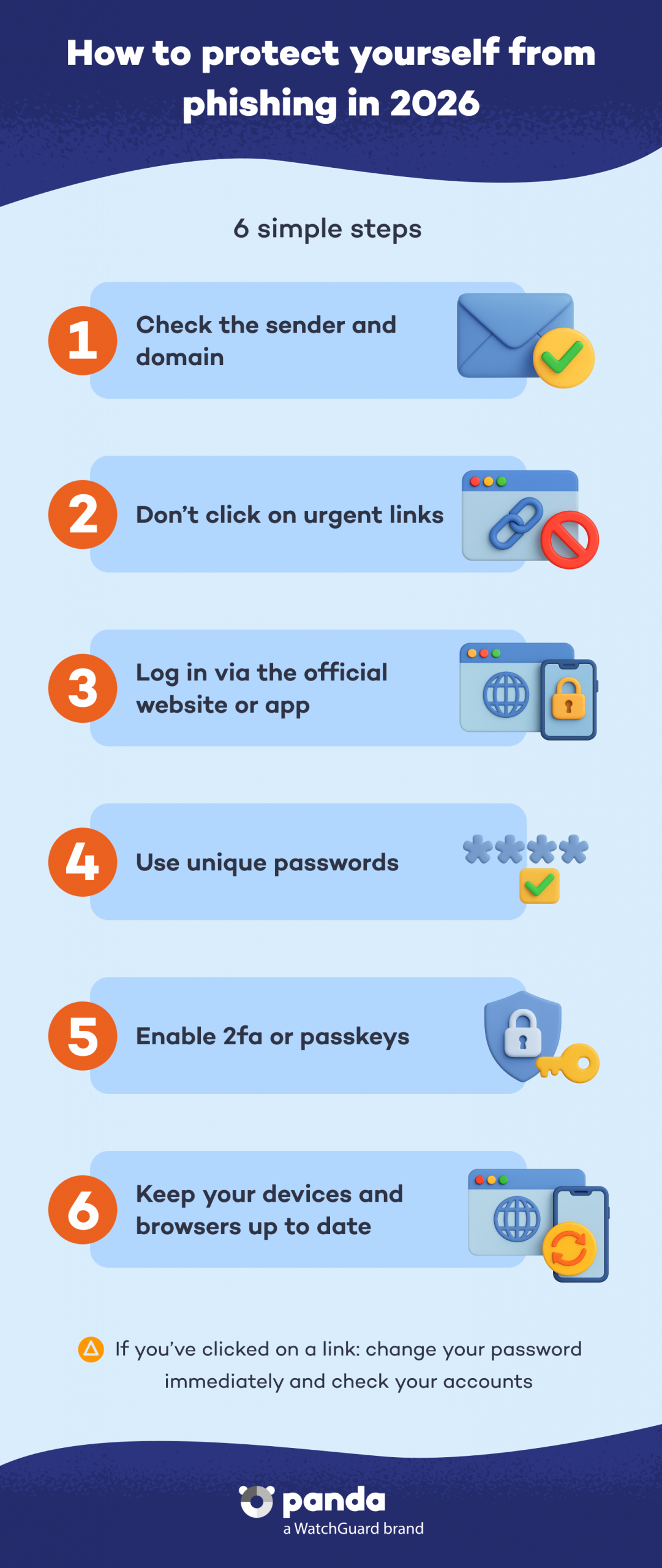

- Keep anti‑malware and your OS updated and enable real‑time protection. This blocks many automatic attacks.
- Treat unexpected messages with caution: verify senders, hover over links to check destinations before clicking, and avoid opening unexpected attachments.
- Use unique passwords and a password manager so stolen credentials can’t be reused across services.
- Enable strong multi‑factor authentication. (Prefer app‑based or hardware tokens over SMS).
- Report phishing to your email provider and to national bodies where available. Reports help block campaigns for everyone.
Learn more about Panda Dome.