


Most social media users feel like they have a handle on their privacy. They know platforms collect their data. They’ve heard the warnings about certain apps. Some have adjusted their settings. The risk feels familiar enough to feel manageable.
But that sense of control is thinner than it looks. In our survey of over 1,000 social media users, just 46% said they actively think about their privacy and take steps to protect it. Most land somewhere short of that, worried but not acting or not thinking about it much at all. Awareness, it turns out, rarely becomes action.
The platform drawing the most concern isn’t the one that’s faced the most political scrutiny, and the fears driving the most anxiety have shifted well beyond cookies and targeted ads. This report breaks down what social media users actually fear, why concern so rarely turns into action and what social media privacy really looks like in 2026.
Key Takeaways
- Out of all the risks on social media, 55% of users are most concerned about AI turning their photos or videos into a fake version of themselves.
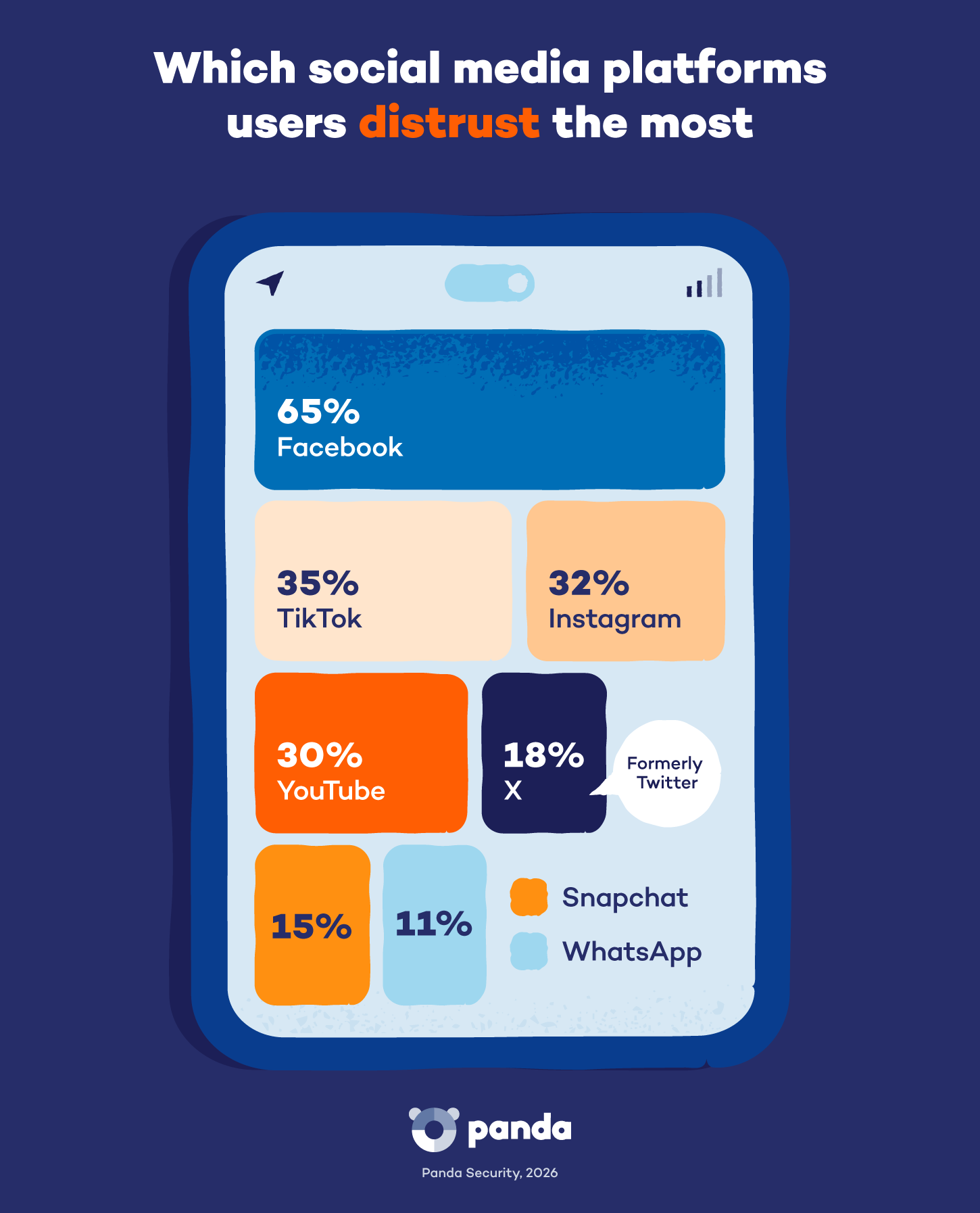
- 65% of respondents selected Facebook as a top concern for personal data collection, nearly double the amount who selected TikTok at 35%.
- One in five (21%) of users are worried about their data but haven’t taken steps to protect it.
- More than one in four people have downloaded an app they knew had poor privacy practices because their friends or family were using it.
Gen Z Stands Alone in Doubting TikTok the Most
Facebook was named by 65% of respondents as a top concern for personal data collection, nearly double the share who selected TikTok at 35%. For most people, that’s probably not the answer they’d expect.
The public conversation around social media privacy has centered heavily on TikTok in recent years, with congressional hearings, proposed bans and ongoing regulatory pressure keeping it in the headlines. But we found that most U.S. adults are looking over their proverbial shoulder at a much older, more familiar platform.

Facebook also allows paid political advertising, a practice TikTok explicitly prohibits. For many users, these aren’t abstract concerns. They’re documented events tied to a platform they’ve been using for nearly two decades.
Gen Z is the only generation where TikTok ranks as the top concern for personal data collection, selected by 52% of Gen Z respondents compared to Facebook at 37%.
| TikTok | ||
|---|---|---|
| Gen Z | 37% | 52% |
| Millennials | 67% | 38% |
| Gen X | 70% | 33% |
| Boomers | 72% | 24% |
Every other generation ranks Facebook first, and by wide margins. For anyone who grew up before TikTok existed, Facebook has simply had more time to lose their trust.
For 1 in 4 Users, FOMO Overrides Privacy Concerns
For more than one in four social media users, the decision to download a problematic app isn’t made out of ignorance. 28% of respondents admitted to installing an app with known data privacy issues because friends or family were already using it. People knew the risk and downloaded the app anyway, because the cost of being left out felt more real than the cost of a privacy breach.
Younger users felt that pull most strongly, with 49% of Gen Z and 41% of Millennials saying they’ve done this, compared to just 21% of Gen X and 12% of Baby Boomers. Missing out on a platform where your friends spend hours every day carries a real social cost and privacy education alone won’t change that behavior if the desire to stay connected is stronger than the fear of exposure.
That same tension shows up in how people manage their existing apps. More than one in five (21%) respondents said they’re worried about their data but feel they haven’t taken enough steps to protect it.
And the most common privacy steps taken in the past year were clearing browsing history or cookies (45%), limiting app permissions (44%) and disabling location tracking (40%). These are all reasonable habits, but none of them address what’s happening in the background while you scroll. Only 23% have used a VPN or private browser and just 19% have cut back on or stopped using social media altogether.
Knowing a privacy risk exists doesn’t automatically translate into knowing what to do about it. Many users carry a general sense of caution without the tools or habits to back it up.
There Is a Privacy Risk from Social Media Flying Under Most People’s Radar
When asked what types of data worry them most, respondents pointed straight to the information that could do the most real-world damage. Sensitive personal identifiers like Social Security or driver’s license numbers topped the list at 50%, followed closely by financial information at 49%. Location tracking, which dominates many policy discussions, ranked much lower at 26%.
Those results show us that people are most afraid of the data that could directly enable identity theft or financial fraud. But the data commonly collected by social media apps (such as browsing habits, app behavior and device activity) rarely shows up on anyone’s radar.
According to the Electronic Privacy Information Center, data brokers use this kind of behavioral data to build detailed profiles on individuals, which can then be used to determine mortgage rates, credit card eligibility and even job applications — often without the person ever knowing.
When asked what would actually make them feel more confident, most respondents wanted more control over what happens to their information. Here’s how their responses broke down:
- 55% said the ability to delete their data from an app completely.
- 51% said more direct control over what apps can access.
- 43% want clearer privacy policies.
- 39% want more consistent data use notifications.
- 27% are interested in third-party security software monitoring.
Most people still associate security software primarily with virus protection, but these tools also monitor app behavior in real time and flag suspicious data collection in the background. As that becomes more widely understood, the demand for them is only likely to increase.
55% Fear AI Will Clone Their Identity Before They Even Notice
With the rise of sophisticated AI, social media users are facing a category of threats that goes well beyond data collection.
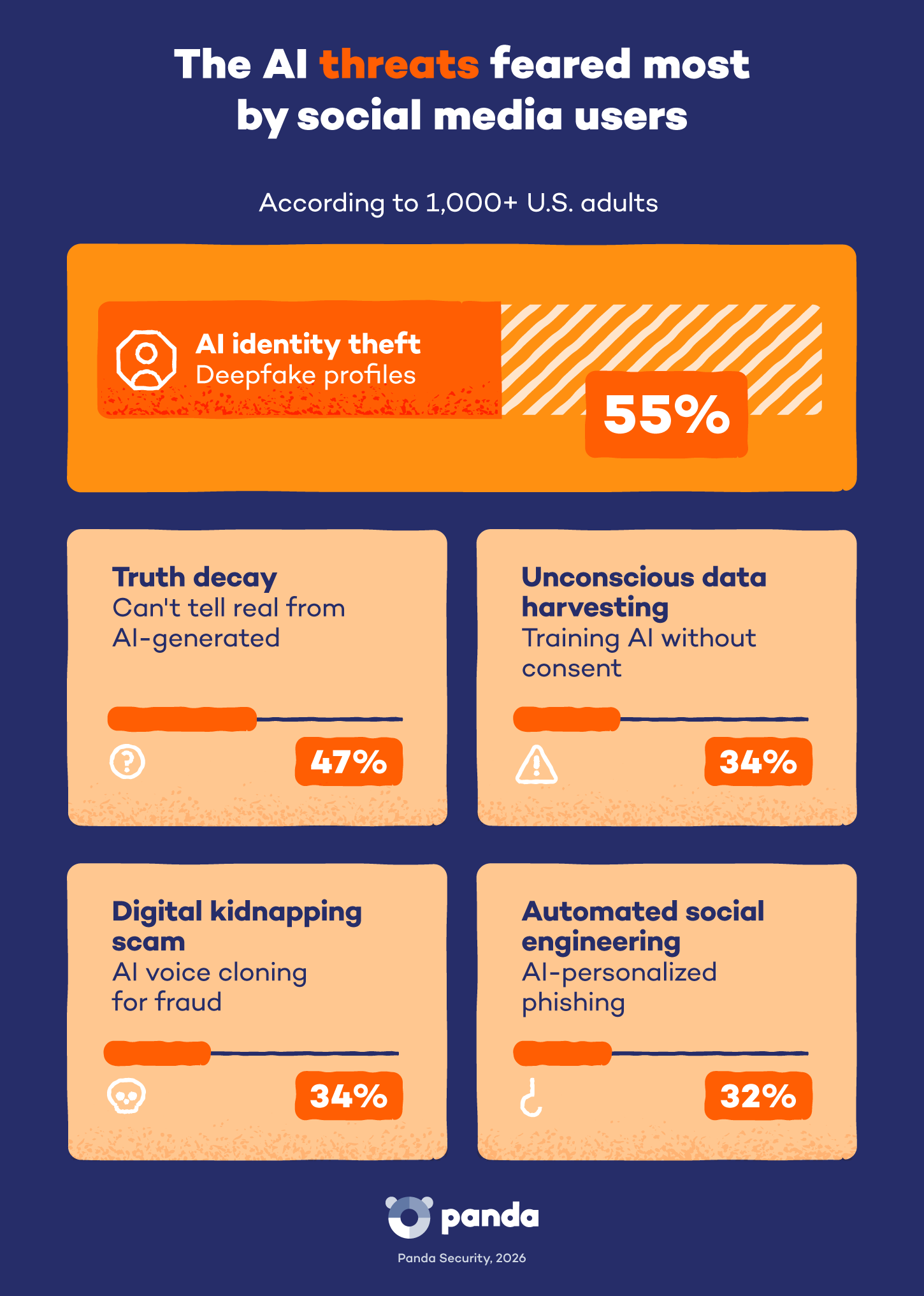
When we asked respondents which AI-related scenarios concerned them most, losing control of their face and voice ranked as the scariest AI threat social media users could imagine. More than half (55%) named AI identity theft as their top concern, specifically the idea of their photos or videos being used to build a deepfake profile that looks and sounds like them.
The fear is well-founded. A deepfake profile can be used to spread misinformation, commit financial fraud, damage someone’s reputation or manipulate people who trust them. A McAfee survey found that one in four adults had experienced or known someone affected by an AI voice cloning scam and 70% were unsure of their ability to distinguish a cloned voice from a real one.
Once someone has enough photos or a video of you, and social media makes that easy, the barrier to creating a convincing fake version of you is lower than many people realize.
Truth decay came in as the second biggest concern, at 47%, reflecting the fear of reaching a point where you can no longer tell what’s real on social media. As AI-generated images and video become harder to detect, the reliability of anything you see online becomes harder to trust.
Unconscious data harvesting worried 34% of respondents, the concern that AI models are quietly training on their private posts and messages without their knowledge or consent.
Digital kidnapping scams, where an AI-generated voice clone is used to impersonate a family member in an emergency and con loved ones out of money, tied for third at 34%. And automated social engineering, where an AI bot studies your interests and sends a perfectly tailored phishing message, concerned 32%.

Many of the steps people are taking to protect themselves, like clearing cookies and adjusting privacy settings, were designed for slower-moving threats. They can reduce your exposure, but they were not designed to defend against someone cloning your identity from publicly available social media content. Deepfakes, voice cloning and AI-generated phishing don’t play by the same rules.
Your Privacy Doesn’t Protect Itself
The social media platforms people fear most and the personal data they most want kept private point to the same underlying anxiety. People are worried about the safety of their entire identity, not just their accounts. And that threat is only getting more sophisticated.
Fortunately, security software like Panda Dome is built to do the heavy lifting that privacy settings can’t. It monitors your devices in real time, flagging suspicious app behavior and data collection before it becomes a bigger problem. As the threats people face on social media grow more personal and more convincing, having protection that works in the background is a practical place to start.
Methodology
The survey was conducted by Centiment on behalf of Panda Security. The survey was fielded from May 29 to June 1, 2026. The results are based on 1,002 completed surveys. To qualify, respondents were screened to be U.S. adults aged 18 or older and active social media users. The data is unweighted, and the margin of error is approximately +/-3% for the overall sample at the 95% confidence level.